
New here? Meet the three principles
Start with three short reminders, familiar pictures, and a little toy play. Then look for the same ideas in each story.
¿Es tu primera visita? Conoce los tres principios
Empiecen con tres frases cortas, dibujos conocidos y un juego de muñecos. Luego busquen esas ideas en cada cuento.
Short words. Small steps. Play together with a caring grown-up.
The Toy We Both Want
A little play about asking for a turn and waiting.
For the grown-up: Make two puppets called Sam and Jo with socks, toys, or your hands. You’ll also need a toy truck—or pretend! Read the lines and do the actions. Let your child join in.
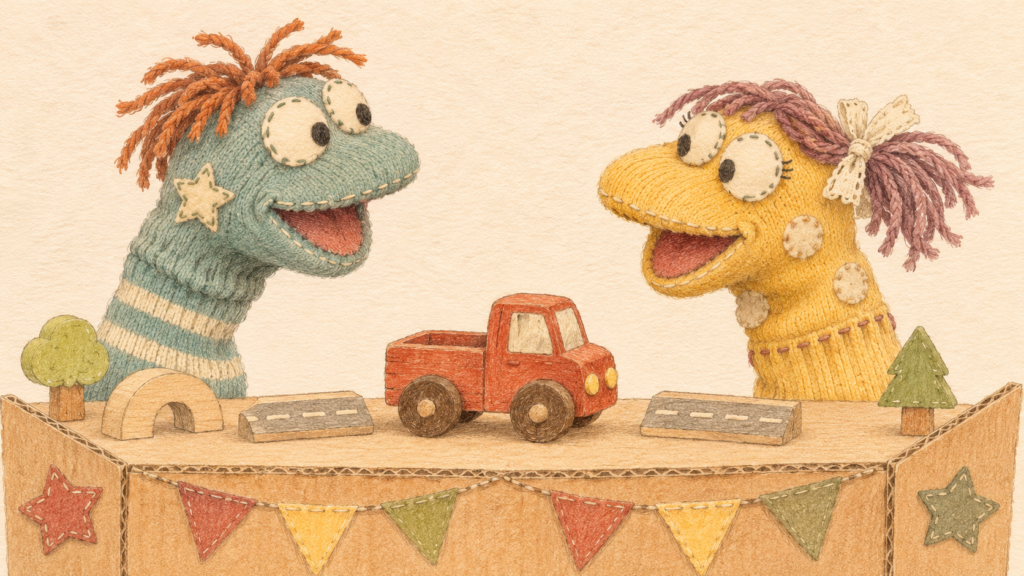
1. “I want it!”
Sam drives the truck.
Sam: Vroom! Off to the park!
Jo: I want the truck!
Sam: I’m still playing.
Jo reaches for it. Stop the play before Jo takes it.
Grown-up: You really want a turn, Jo. I won’t let you take it from Sam.
2. “Can I have it next?”
Ask your child: What could Jo say? Pause and listen. Help with the words if needed.
Jo: Can I have it next?
Sam: Yes. One more trip to the park. Then it’s your turn.
Jo: I’ll make a bridge!
Make a bridge with your hand. Sam drives under it.
Sam: Beep, beep! Coming through!
3. “Your turn!”
Sam reaches the park and gives Jo the truck.
Sam: Here you go!
Jo: Thanks! Vroom, vroom!
Sam: Can I have a turn after you?
Jo: Yes!
Try it again: Switch puppets. Let your child ask for a turn or help the puppet wait.
For the grown-up: Keep the promised turn short and make sure it happens. Waiting is hard at this age. Help your child while they wait; they don’t have to stop feeling upset before you help.
El juguete que los dos queremos
Un pequeño teatro para practicar cómo pedir un turno y esperar.
Para el adulto: Haz dos títeres llamados Sam y Jo con calcetines, muñecos o tus manos. Necesitas un camión de juguete, ¡o pueden imaginarlo! Lee las frases y haz los movimientos. Deja que tu hijo participe.
1. «¡Lo quiero!»
Sam mueve el camión.
Sam: ¡Brrrm! ¡Al parque!
Jo: ¡Quiero el camión!
Sam: Todavía estoy jugando.
Jo intenta tomarlo. Detén el juego antes de que se lo quite.
Adulto: Quieres un turno, Jo. No voy a dejar que se lo quites a Sam.
2. «¿Me toca después?»
Pregunta a tu hijo: ¿Qué podría decir Jo? Haz una pausa y escucha. Ayuda con las palabras si hace falta.
Jo: ¿Me toca después?
Sam: Sí. Una vuelta más al parque y te toca.
Jo: ¡Voy a hacer un puente!
Haz un puente con tu mano. Sam pasa por debajo con el camión.
Sam: ¡Pip, pip! ¡Voy pasando!
3. «¡Te toca!»
Sam llega al parque y le da el camión a Jo.
Sam: ¡Aquí tienes!
Jo: ¡Gracias! ¡Brrrm, brrrm!
Sam: ¿Me toca después de ti?
Jo: ¡Sí!
Otra vez: Cambien de títere. Deja que tu hijo pida un turno o ayude al títere a esperar.
Para el adulto: Que la espera sea corta y que el turno prometido llegue de verdad. Esperar cuesta a esta edad. Acompaña a tu hijo mientras espera; puedes ayudarlo aunque siga enojado.
Six little choices to act out
- My brother took my toy. Say “Stop. I am using it.” Ask for help if you need it.
- I want to bite. Step back. Say “I’m mad.” Get a grown-up. Do not bite people. A grown-up can help you move away and tell them what upset you.
- The toys are all over. Pick one kind of toy to put away. Ask someone to help with the rest.
- I don’t want to brush. Tell a grown-up what feels hard. Choose a song or ask for help while you care for your teeth.
- I don’t like this food. Use kind words: “I don’t like this yet.” A grown-up can help. You do not have to pretend you like it.
- My shirt is on the floor. Put it in the wash bin. You can take care of a shared space.
For the grown-up
Read one situation, not all six at once. Ask “What could you do?” Accept a gesture, a drawing, or a few words. Model the words when a child needs help. Praise the specific choice: “You told me what happened.”
Feeling angry or needing help does not make a child bad. First stop harm and care for anyone hurt. Help the child practice a safe next action. Make the task small enough to try. Before assuming a child simply refuses to cooperate, ask whether something hurts, feels frightening, is too loud or uncomfortable, or whether they are tired.
Never use these principles to demand hugs, silence, forced eating, or obedience to an unsafe request. A child can say no, move away, and seek a safe adult.
Choose a picture story to read together →
Created and developed by Wayne Schmidt for the BYTS Movement with AI assistance.